
Decatur County Arrest Records and Court Charges
Arrest records begin with the law-enforcement event. In Decatur County, the sheriff's booking channel may show current confinement, admits by date range, charges, and arresting agency filters. The sheriff's official inmate bookings page warns that inmate images are not available under Georgia open-records exemption authority and that charges displayed there are not finalized until reviewed by prosecutors or courts. That warning is central. Booking data can identify custody and alleged charges, but it does not prove conviction or final disposition.
Court charge records begin when the legal accusation moves into the court process. The Clerk of Superior Court files and processes executed warrants, indictments, accusations, sentences, sentencing packages, and post-conviction matters. Magistrate Court is important for warrants, first appearances, and bonds. State Court handles misdemeanors and traffic-related criminal matters. Superior Court handles felonies. For custody and booking details, use the inmate records route; for the complete case file and outcome, use the Decatur County criminal court records page.
The Decatur clerk useful links page collects local and state justice-agency links that help connect arrests, court charges, custody, and criminal-history resources.
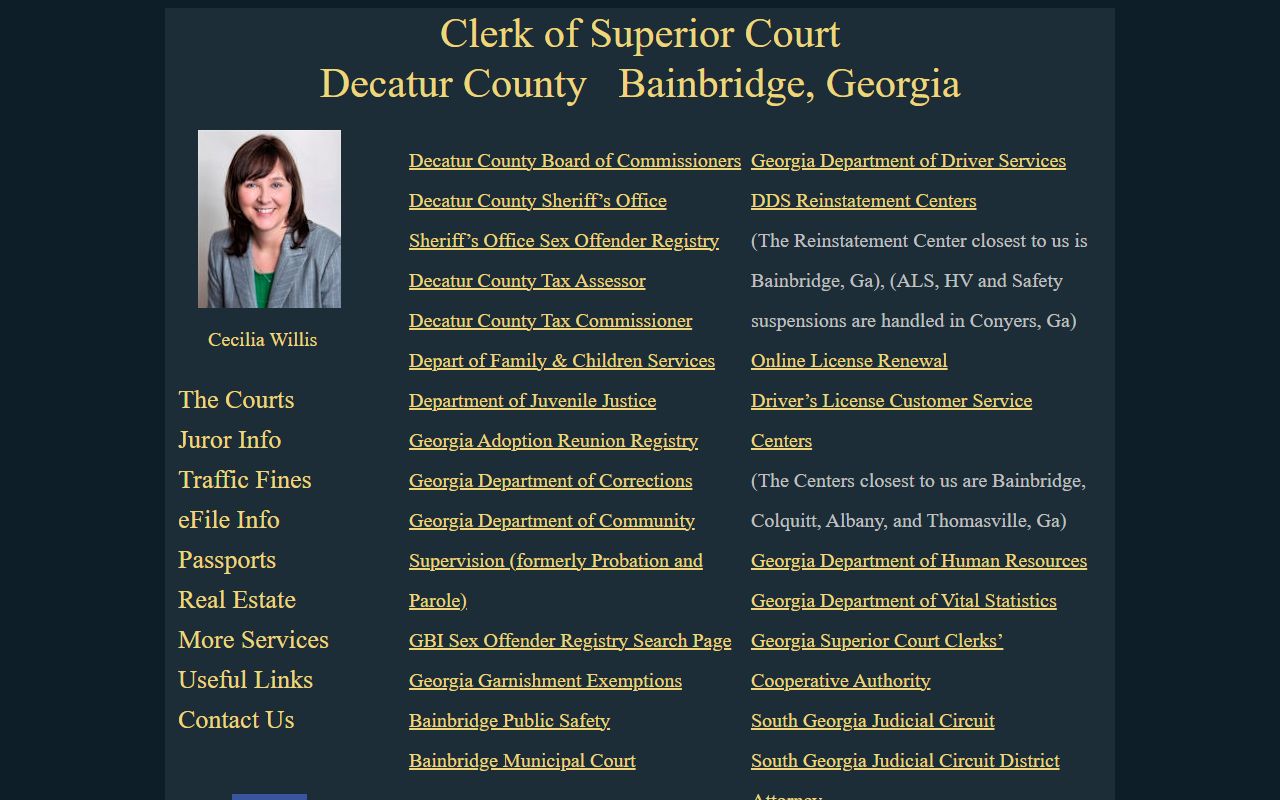
The clerk links image supports charge research because Decatur records often require both court and law-enforcement channels.
Find Decatur County Arrest Records
The arrest side starts with the Decatur County Sheriff's Office and jail roster. The sheriff is located at 912 Spring Creek Road in Bainbridge, with the main sheriff phone listed as 229-248-3044 and jail contact as 229-248-3049 or 229-248-3050. The Southern Software Citizen Connect inmate confinement search is the public roster route for current custody, admits by date range, charge filters, and arresting agency filters. The search should not be treated as a mugshot database because images are not available from the sheriff page.
- Check whether the person is in current county custody through the sheriff's Citizen Connect roster or by calling the jail.
- Record the arresting agency and displayed charge, but do not treat the displayed charge as final.
- For first appearance, warrant, or bond questions, use Magistrate Court or jail contacts tied to the Spring Creek Road complex.
- For formal court charges, contact the Clerk of Superior Court and identify whether the case is State Court misdemeanor or Superior Court felony.
- For the final outcome, request the criminal court record, disposition, or certified sentence from the clerk.
The Georgia Department of Corrections offender search page is a separate state custody channel for sentenced state-prison records, not a Decatur County arrest database.
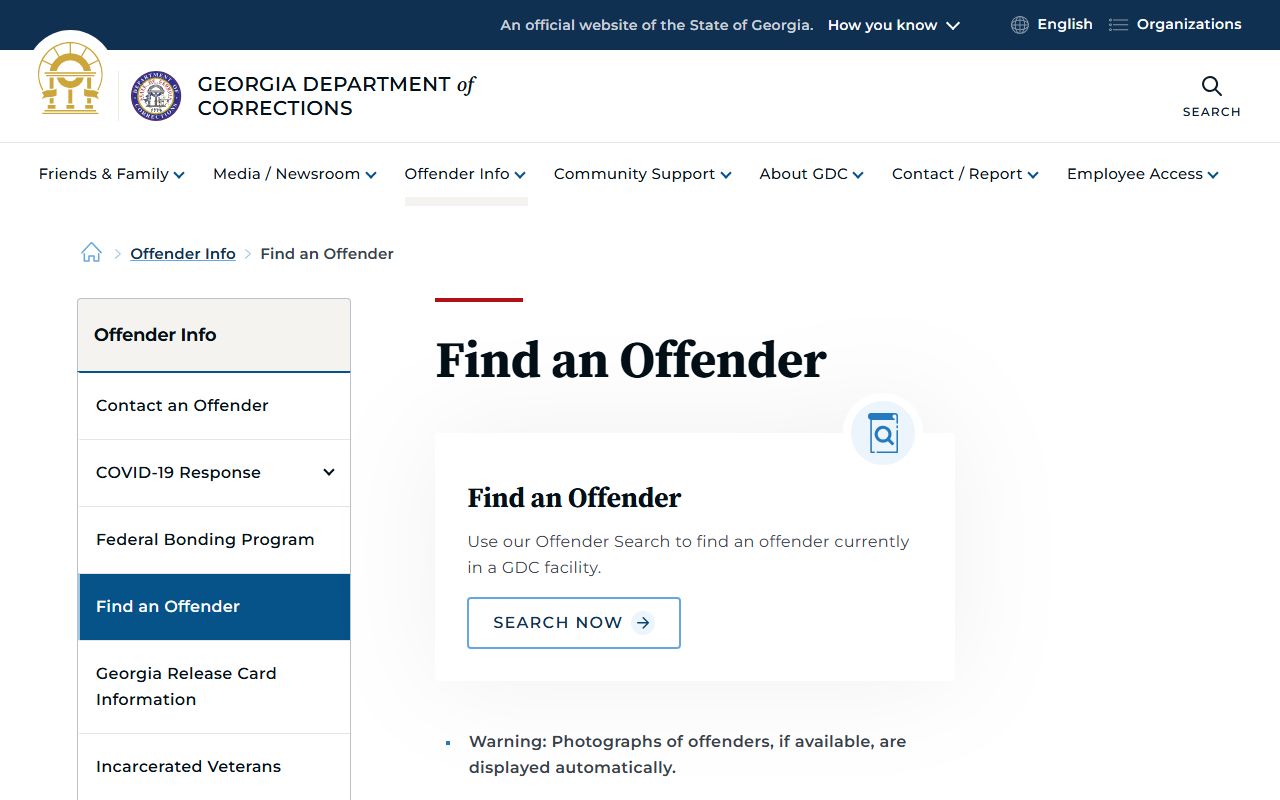
The GDC image helps separate county arrest records from later state custody records after sentencing.
Charges After Arrest Documents
Charges after arrest move through documents that define what the court will consider. A complaint or warrant-related paper may appear early. An accusation is a formal charging document often used in misdemeanor and some criminal prosecutions. An indictment is a grand jury charging document in a felony case. In Decatur County, Superior Court felony matters are prosecuted by the South Georgia Judicial Circuit district attorney, while State Court misdemeanors are handled by the Solicitor General's office listed on the clerk's State Court page.
| Document | Who Uses It | Decatur County Context |
|---|---|---|
| Complaint or warrant paper | Officer, prosecutor, Magistrate Court, or court process | May support first appearance, bond, warrant, or early case activity. |
| Accusation | Prosecutor | Used for State Court misdemeanors and some criminal prosecutions before the court. |
| Indictment | Grand jury and prosecutor | Common felony charging paper in Superior Court cases. |
Charge Status in Decatur Records
A charge can change after arrest. Prosecutors may amend, reduce, add, dismiss, or decline a count. A court may enter a plea, verdict, sentence, dismissal, or nolle prosequi. A nolle prosequi means the prosecutor is not pursuing that charge at that time. A disposition is the outcome. A sentence is the punishment or set of terms imposed after a plea or conviction. Because one arrest can produce several separate charges, each count needs its own status check.
| Status | What It Means | Where to Confirm |
|---|---|---|
| Pending | The charge is still open or has not reached final disposition. | Clerk docket, court calendar, prosecutor, or court office. |
| Amended or reduced | The charge changed from the original booking or filing language. | Latest accusation, indictment, order, or disposition entry. |
| Dismissed | The court or prosecutor ended the charge without a conviction on that count. | Disposition, dismissal order, or certified court record. |
| Nolle prosequi | The prosecutor chose not to pursue the charge at that point. | Prosecutor filing or court disposition. |
| Convicted | The charge ended in a guilty plea, verdict, or qualifying final outcome. | Disposition, sentence, and clerk-certified record. |
Charges vs Convictions
Arrest records and court charge records are often misread because the same charge words can appear at different stages. A booking charge may be the arresting agency's entry. A court charge is the allegation filed or accepted into the court process. A conviction is the result after a plea, verdict, or qualifying adjudication. Decatur County readers should look for disposition and sentence before treating any charge as the final result.
| Point | Charge | Conviction |
|---|---|---|
| Meaning | An allegation after arrest or formal filing. | A final guilty outcome or qualifying court result. |
| Who reviews it | Prosecutor and court after arrest. | Judge or jury process, or plea accepted by the court. |
| Can change | Yes, charges may be amended, reduced, or dismissed. | The sentence or record status may later change through post-conviction or restriction routes. |
| What to request | Charging document, docket, or latest charge list. | Certified disposition, sentence, or final judgment. |
Bond and Warrant Risk
Bond records are often tied to arrest and charge research. The Decatur jail page says a criminal bond is a financial guarantee that the person will appear in court and that a bond is not a fine. Failure to appear may cause bond forfeiture and a bench warrant ordered by the judge. The jail also warns not to pay bail or bonds by telephone and says bond information should be verified directly with Decatur County Jail. A $20 State of Georgia fee applies for every bond written by the jail, with a 3.5 percent convenience charge for debit or credit card payments.
Property bonds have local limits. Decatur County property must exceed the bond value, proof such as deed or tax receipt may be required, all owners of record must sign, and the sheriff or designee must approve. Professional bondsmen are listed in the booking lobby, but the sheriff does not recommend one. These bond facts matter because a charge can remain pending even when a person is out of custody.
Note: Verify bond status with the jail, but do not send telephone bond payments to callers claiming to collect them.
Statewide Charge and History Lookups
State systems answer different questions than Decatur County arrest records. GDC Find an Offender is for state-prison custody and sentenced offenders, not local active arrest records. The GBI criminal history record restriction page explains Georgia restriction under O.C.G.A. 35-3-37. The sex offender registry is a separate state and sheriff-linked route. A person checking charges after arrest should avoid mixing county booking status, court charges, state criminal history, sex offender registry records, and prison custody into one record type.
When a Decatur arrest leads to a possible criminal-history restriction, the path depends on the arrest date and result. For many arrests after July 1, 2013, the person contacts the prosecutor instead of filing an application with the arresting agency. For older arrests, the arresting agency may be involved. Felony matters route to the South Georgia Judicial Circuit district attorney. State Court misdemeanors route to the local State Court prosecution channel.
The Georgia Governor open-records request page is the statewide public-records fallback when a record must be requested from the agency that maintains it.
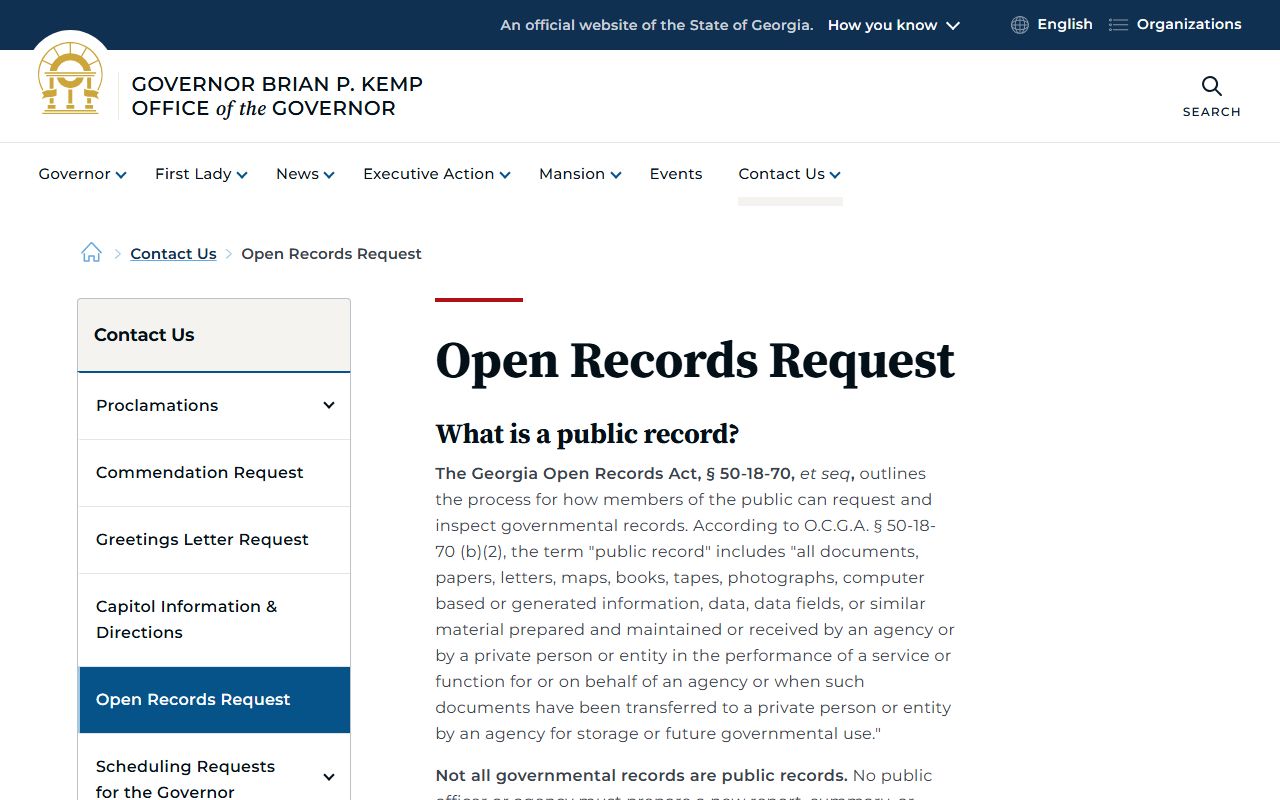
The open-records image supports the fallback route when no ordinary Decatur online lookup provides the needed charge or agency record.
Sealed vs Restricted Charge Records
Georgia's public access rules allow many court records to be inspected, but charge records can become restricted or sealed. A sealed court record is hidden from public access by law or court order. A restricted criminal-history record is limited for noncriminal-justice purposes under Georgia law when the record qualifies. Decatur County charge records can also include juvenile, medical, mental-health, financial, or personal-identifier information that is redacted even if the docket remains public.
| Point | Sealed Record | Restricted Criminal History |
|---|---|---|
| Main effect | The court file or part of it is not public. | The criminal-history entry is limited for noncriminal-justice use. |
| Common route | Motion, petition, court order, or statute. | GBI guidance, prosecutor review, or arresting-agency process depending on date. |
| Decatur contact | Clerk and court tied to the case. | District attorney, solicitor, or arresting agency depending on the record. |
| Limit | Does not mean all related agency records vanish. | Does not automatically rewrite every court docket or jail entry. |
Restricted Decatur Charge Records
Restricted charge records include juvenile matters, sealed records, eligible restricted criminal history, ongoing sensitive law-enforcement records, and records with protected identifiers. The clerk's redaction guidance lists Social Security numbers, mother's birth name, credit and debit card information, financial data, insurance and medical information, unlisted phone numbers, cell phone numbers, and day and month of birth. Those details should not be expected in a public filing or copy.
The Decatur clerk can locate, file, process, and retrieve court records, but cannot advise a person how to plead, what motion to file, or whether a charge qualifies for restriction. The District Attorney's Office can be the correct starting point for felony restriction review after newer arrests. The Solicitor General's office is relevant for State Court misdemeanors. The arresting agency, such as Decatur County Sheriff's Office or Bainbridge Public Safety, may be part of older arrest-record restriction processes.